Tuesday, December 30, 2008

December 2008


Isabelle, a 3-month old Jersey calf, arrived this month. I built a small pen and metal-clad shed for her on the eastern side of the property, with plans to fence a larger western pasture soon. It will be some time before she's ready to be bred and produce milk, but that gives me time to learn about dairy cows.

It will also provide more time to learn the art of cheese-making. I took NCSU's 3-day Farmstead Cheesemaking short course this month and came away with a couple pounds of cheese—and a couple pounds heavier from daily cheese-tastings.

Apple and pear trees went into the new orchard and nearly 5-pounds of garlic was planted in the garden. Cold and wet weather continue to make for a lot of indoor days.

Sunday, November 30, 2008

November 2008

The heirloom apple and pear trees arrived this month. I've scoped out a northeast facing slope beyond the hoop house for the orchard. However, five days of rain have soaked the ground, delaying their planting.

Organic seed potatoes also arrived from Milk Ranch. I'll plant La Ratte and French fingerlings, Rose Finn Apple, Garnet Chile and Yellow Finn varieties come early Spring.

Thursday, October 30, 2008

October 2008

This month brought the highly-coveted, County-issued "certificate of occupancy" for the temporary house. Without it, there is no power to the house. No house number on the mailbox. No legitimacy with the local government. And, as far as I've been able to ascertain, there is no step-by-step guidebook for do-it-yourself building neophytes. What have I learned in the process? You can request a free consultation with an inspector prior to having them inspect. I discovered this important piece of information on the day of the first inspection, right before I failed. Two weeks and another $50 later, all items passed.

Tuesday, September 30, 2008

September 2008

I finally have water in the new pond after Hurricane Faye's remnants brought more than 5-inches of rain in one day, closing out a dry August. Hurricane Gustav topped off the remainder with another 5-plus inches. Hopefully I'll be able irrigate the new apple and pear trees I've ordered by pumping water to the orchard. The trees will arrive in November from Century Farm Orchards, which specializes in the preservation of old Southern varieties. Just as I prefer to grow only heirloom vegetables, I think it's important to preserve heritage fruit and nut trees. I'll grow Kieffer and Seckel pears, and apple varieties include William's Favorite, Bevan's Favorite, Aunt Rachel, Grimes Golden, Blacktwig and Old Fashioned Winesap.

Organic garlic is also on the way from Hood River Garlic, with delivery scheduled this month. Varieties include Early Italian Red, Red Toch, Shantang Purple and Susanville.

The eggplant crop is finally coming in—at least the few plants the Colorado Potato Beetles left me. Covered in homemade tomato sauce, the eggplant makes a fabulous parmiagiana.

Sunday, August 31, 2008

August 2008

Up to my eyeballs in tomatoes, canning season is off to a good start. After 8 to 10 hours at my day job, I was back at the farm in the evening for picking sessions followed by canning the harvest. I'll have plenty of vegetables stored for the winter -- canned tomatoes, sauces, salsas, preserves, jams and jellies, green beans and black-eyed peas. Quart bags of wonderberries, squash and melon have pushed the freezer's holding capacity. Fresh melons are still coming in daily, providing plenty of vitamin C.

Putting up food from the harvest provides a satisfying sense of accomplishment and independence. I'm controlling what goes into my food and into my body. No chemicals or pesticides go into the garden. Nothing is genetically-modified. No endocrine-disrupting bisphenol A lining the inside of canned goods. Seems home food preservation is making a comeback as people begin to take charge of their food again. (Read Preserves Become Ideology in a Jar).

Monday, June 30, 2008

July 2008


As June rolls into July, I continue to enjoy a good harvest. Over 80 lemon cucumbers were picked in just one day. Tomatoes are now in -- grape, paste and Homestead varieties, and melons are about ready. I'm still battling a few hornworms and potato beetles, but so far handpicking is working. Check out my What's Growing page to see the full list.The first wonderberries came off the bush and into a pie this month. The general consensus is that they're better than blueberries when baked.

June 2008

Zucchino Rampicante turns out to be a VERY prolific squash. The skin is tough, so must be peeled, and the pulp is similar in taste to a winter squash. Cut into slices and sautéed in olive oil, it's quite good. Rare Seeds, my source for heirloom seeds, says it's good for baking so suspect this will turn up in a pie soon.

Lemon cucumbers are also coming in and the bees are very fond of their flowers. Melons are also doing quite well and should be ready to pick soon.

Work has finished on the long driveway into the property, up to the temporary home and back to the middle pasture where the future house and cottage will go. See driveway photos. It took many loads of dirt to raise the driveway's low spots. Because the front pasture had an area that was consistently wet, I pulled dirt from this area and had it sculpted into what is now a one-acre pond—or rather, a one-acre hole. Heavy rains moved in the day after the crew finished the pond, leaving a few puddles of water. It will take awhile to fill. As the rain fell, a dinner-plate size snapping turtle dragged itself to the top of the pond wall and stared out into the hole.

After the dirt-moving equipment finished the first day of work in the pond area, I found a woodland vole running frantically in circles across the large expanse of sun-baked earth left void of its vegetation. I deposited it in a nest of leaves in the small forested area next to the Bee Haven. This brings up a difficult question. One of my goals is to care for and nurture our land, yet heavy equipment, in the process of establishing the farm infrastructure, leaves uprooted trees, bare exposed earth and displaced creatures. How do I reconcile my need to make space for a farm and meet my goal of treating the Earth gently?

Treating the Earth gently is one thing. Sharing my produce with Tobacco Hornworms is quite another. I discovered them feasting on tomatoes and wonder berries. For now, hand-picking the worms appears to work, and as an added bonus, provides fishing bait. I hooked, then returned, a Bluegill Sunfish from the small pond using the hornworm as bait.

The bees now have a third 8-frame super on each hive. I added a queen separator between this box and the last. If they're able to fill the box, perhaps I'll get honey this year after all.
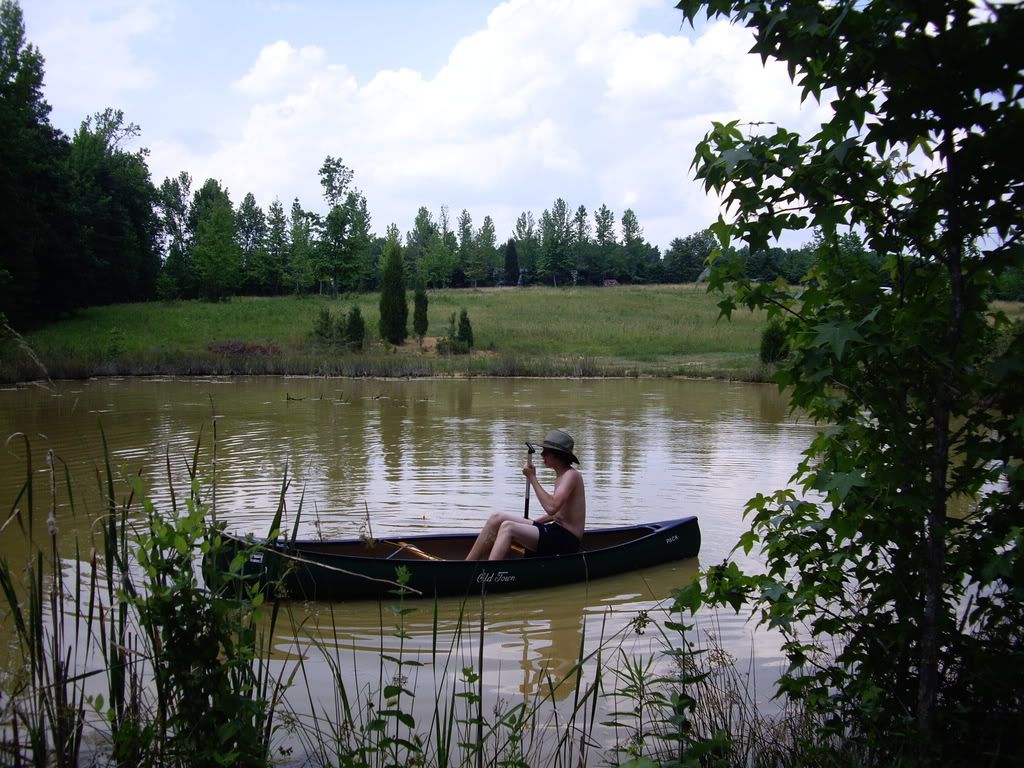
The 100-degree plus heat wave continues, making movement in the garden slower than usual. Sometimes you just have to take a break and paddle for awhile. My son put a canoe out on the pond for just that purpose.

I've harvested the first crops, purple plum radish and summer squash. Tomatoes, beans, peas and more are progressing. Eggplant has been decimated by Colorado Potato Beetle. See garden photos.

Drip tape is hooked-up and I'm now able to water the garden using the generator to operate the well pump.